

Your bike tour is approaching, and there’s one detail you shouldn’t underestimate: bike fitting for your rental bike.
When we talk about bike fit, we mean how your body and the bicycle work together to ensure comfort, efficiency, and enjoyment, especially on multi-day cycling tours.
But fear not! We’re not about to dive into bike geometry or cycling biomechanics.
We’ll keep things simple and practical, focusing on how to get a comfortable, safe fit on a rental bike – no professional fitting required.
After deciding the type of bike among the ones offered by your bike tour company (such as the different bikes available on Tourissimo cycling tours) it's time to talk about bike size and bike fitting.
Bike Size: Why It Matters When Renting a Bike
How important is bike size? Very important.
Think of your bike like your running shoes. Would you run long distances in shoes that aren’t your size? You probably could. But it wouldn’t be comfortable (😢).
The same logic applies to a rental bike on a cycling tour. A bike that’s too big or too small can lead to discomfort, pain, and even injury.
Bikes come in different sizes based on the frame.
The frame is made of tubing forming a front and rear triangle (often called a “diamond frame”).
Larger frames suit taller riders
Smaller frames suit shorter riders.
Bike Fit vs Bike Size: What’s the Difference?
Bike size and bike fit are not the same thing.
While the frame determines the overall size of the bike, bike fit depends on how the contact points interact with your body.
The main contact points between your body and the bike are:
-
Saddle (seat)
-
Pedals
-
Handlebar (and stem)
These components directly affect comfort, posture, and handling and can often be adjusted or swapped, even on a rental bike.
Good news: Most bike manufacturers already optimize these components based on frame size, meaning a small bike usually comes with a shorter stem and narrower handlebars.
Remember: Your bike should adapt to your body – not the other way around.
Usually, a smaller bike typically comes with a narrower handlebar and a shorter stem, which suits most riders of that size.
Bike sizing can be expressed in different ways:
- Road bikes are traditionally measured in centimeters (cm)
- Mountain bikes are measured in inches (in)
- Some brands use Small, Medium, Large
Regardless of the label, what really matters are the measurements and angles of the frame’s front triangle.
What Information to Share With a Bike Rental or Tour Company
About you:
-
Height (measured without shoes)
-
Inseam (seat height): This measurement is easy to get wrong. Only provide it if you’re confident in how it’s measured.
-
Body proportions (e.g. long legs, short torso)
-
Health considerations (neck stiffness, knee issues, recovery from surgery)
About your personal bike (if you have one):
-
Make and model
-
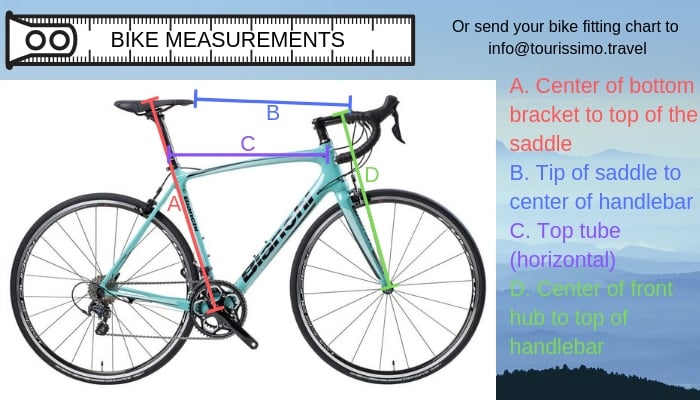
Frame size as stated by the manufacturer. Usually on a sticker or engraving. If needed, you can also measure it manually (picture below).
-
Bike fit measurements (in centimeters, if possible)
You have to measure how the contact points (saddle, pedals, handlebar) relate to one another (usually in centimeters).
Over the years, we’ve found that a a bicycle picture and legend explains better than any description what and how to measure your bike fit.
Final Adjustments Once You’re on Tour
With this information, your rental bike can be prepared with a nearly perfect fit before your cycling tour begins.
On the first ride, you should listen to your body and see what adjustments need to be made.
If you ever invest in a professional bike fitting, you’ll receive a detailed setup chart – something worth sharing whenever you rent a bike or book a cycling tour.
Also, proper bike fit is just one part of getting ready for a cycling tour.
Packing the right gear and preparing your body before departure can make an equally big difference!